

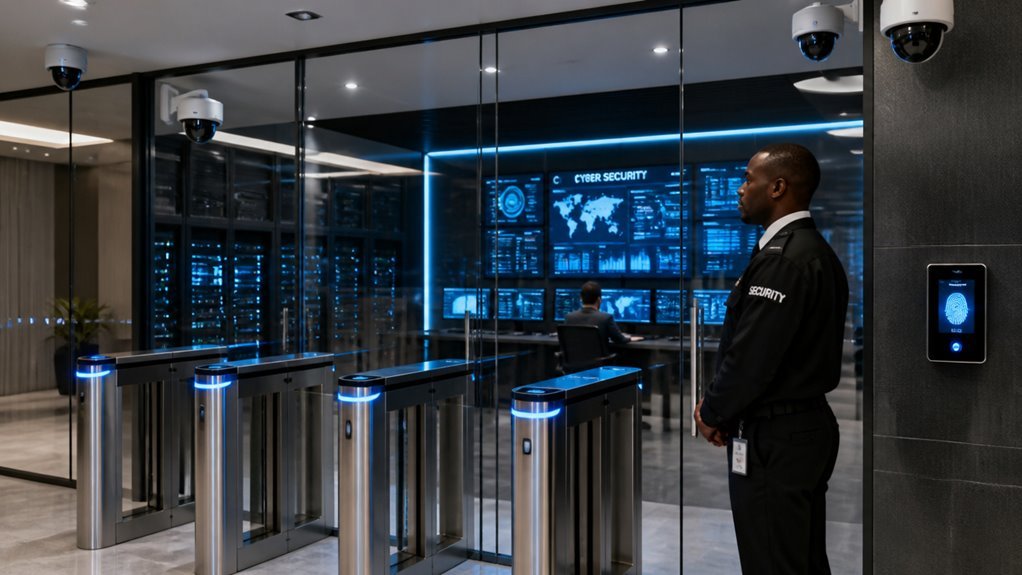
Physical security and cybersecurity serve different yet interconnected purposes, protecting assets from distinct threats. Physical security safeguards facilities, hardware, and access points through measures like locks and surveillance. Cybersecurity defends digital information against hacks, malware, and data breaches. Both are essential; combining them provides layered defense against physical tampering and cyberattacks. An integrated approach enhances comprehensive safety, but challenges arise in managing access and detecting threats across domains. Understanding how these elements work together is key to developing effective security strategies.
Key Takeaways
- Physical security prevents unauthorized access to tangible assets, while cybersecurity protects digital data and systems; both address different vulnerabilities.
- Physical security breaches can facilitate cyberattacks, highlighting the necessity of integrated, layered security measures.
- Combining both ensures comprehensive protection against evolving threats across physical and digital environments.
- Centralized identity and access management enhances security, accountability, and reduces risks in both domains.
- A holistic security approach improves incident response, threat detection, and compliance with standards.
Understanding the Differences Between Physical Security and Cybersecurity
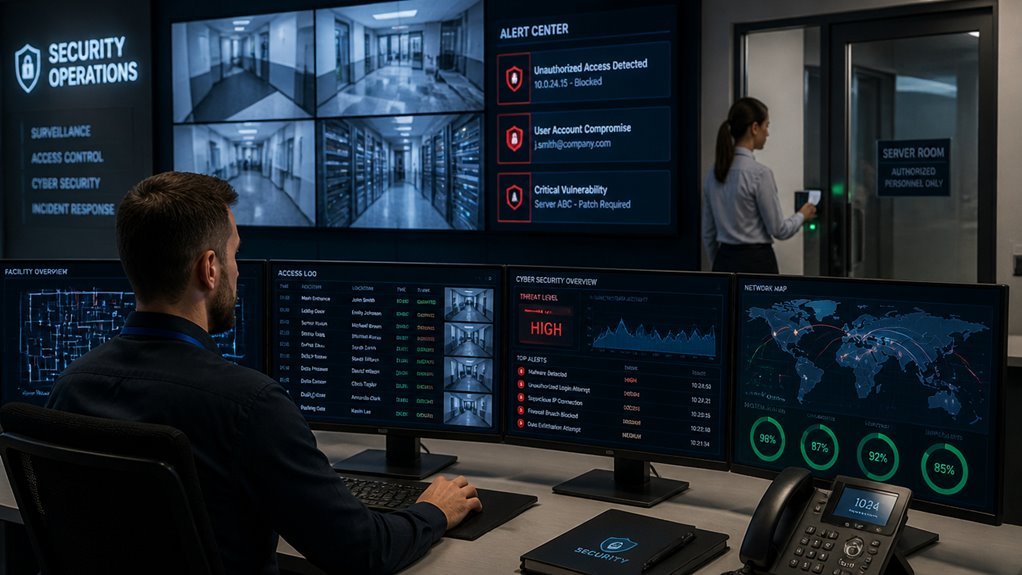
Have you ever wondered how physical security differs from cybersecurity? Physical security protects tangible assets such as buildings, hardware, and personnel using physical security devices, access control systems, surveillance cameras, barriers, and intrusion detection systems. In contrast, cybersecurity safeguards digital assets, including data, applications, and networks, through cybersecurity measures like firewalls, encryption, and authentication protocols. While physical security relies on manual interventions and layered security, cybersecurity uses automated threat detection and prevention methods. Both domains aim to prevent security breaches, but their approaches address different vulnerabilities. Understanding these distinctions is vital for comprehensive protection, as physical access can lead to cyber threats and vice versa. Additionally, security guard duties play a critical role in enforcing physical security measures and maintaining a vigilant security presence.
Why Are Physical Security and Cybersecurity Both Essential?
Both physical security and cybersecurity serve as vital components of an organization’s comprehensive defense strategy, often intersecting to protect different aspects of assets and information. Physical security safeguards tangible assets, such as hardware and facilities, while cybersecurity secures digital assets stored on networks. Weak physical security, like unauthorized access to server rooms, can lead to security breaches or data theft. Integrated security creates a layered defense, reducing risks associated with physical vulnerabilities and enabling threat detection at multiple points. Combining access control with threat monitoring ensures comprehensive protection, making both physical security and cybersecurity essential to prevent exploits that compromise an organization’s entire security posture. Additionally, security guard training requirements emphasize the importance of understanding both physical and cybersecurity principles for effective security management.
How Do Physical Security Measures Complement Cybersecurity Defenses?
Physical security measures serve as a vital complement to cybersecurity defenses by preventing unauthorized physical access to critical infrastructure and digital assets. Security systems such as access badges, surveillance, and locked server rooms help control access points and detect threats early. Securing hardware and infrastructure physically limits opportunities for tampering or theft, reducing cyberattack risks. These security controls identify and deter insider threats attempting to breach digital systems physically. Integrated security combines physical and digital layers, creating comprehensive defenses. Threat detection through physical protections enhances cybersecurity, forming a multi-layered approach that minimizes vulnerabilities and supports generally safety. Additionally, implementing Access Control Systems allows organizations to manage and monitor physical access efficiently, further strengthening overall security.
The Role of Identity Verification and Access Control in Security
Effective security systems depend heavily on verifying the identities of individuals seeking access, whether to physical locations or digital assets. Accurate identity verification and access control reduce the risk of breaches by ensuring only authorized individuals gain entry. Multi-factor authentication, combining biometrics, smart cards, and PINs, strengthens digital security across physical and digital environments. Real-time logging and audit trails promote accountability and enable threat detection by monitoring unauthorized activities. Integrating physical and digital access controls through a unified platform improves response capabilities. In general, robust access management safeguards assets and supports a secure environment by minimizing vulnerabilities like shared credentials and lingering access rights. Identity management systems further enhance security by centralizing control and streamlining credential verification.
How Are Threats Detected in Physical and Digital Security?
How do security systems identify and respond to potential threats in physical and digital environments? Physical security relies on manual surveillance, intrusion detection sensors, CCTV footage, and security personnel observation for threat detection. Visual confirmation and sensor triggers help detect security breaches, with response times varying by facility size. Digital security uses automated alerts, network traffic analysis, and anomaly detection algorithms to identify threats rapidly. Real-time monitoring enables immediate response to cyber threats, often within seconds. Combining these systems, through integrated threat detection, enhances early warning capabilities, providing comprehensive safety. Both physical and digital systems focus on timely and accurate threat identification to prevent harm.
Benefits of Linking Physical and Cybersecurity Systems
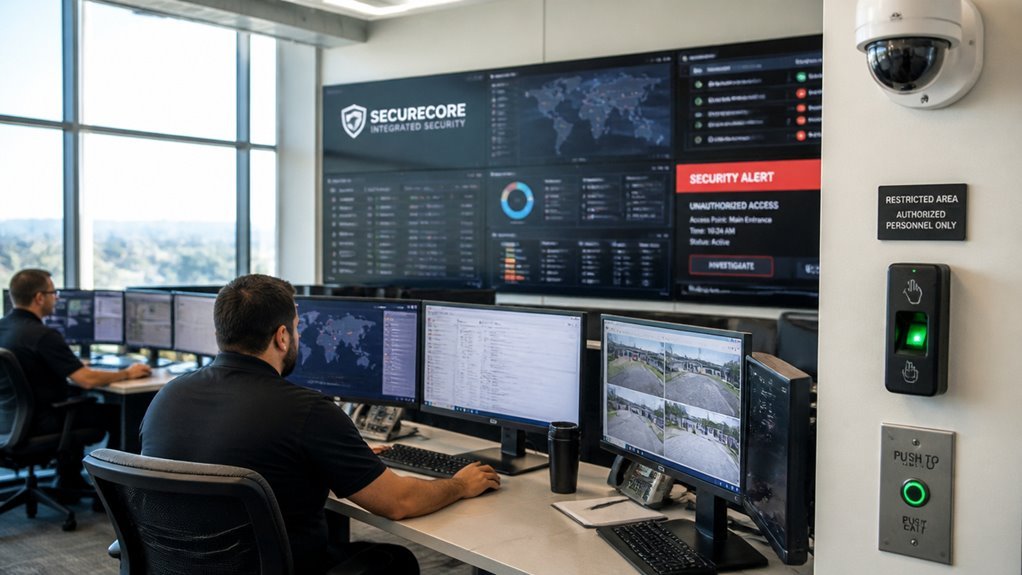
Linking physical and cybersecurity systems offers significant advantages by creating a unified approach to security management. Integrated systems enable unified identity management, reducing risks from credential sharing and unauthorized access. By consolidating physical and cyber assets, organizations improve incident detection and threat detection, facilitated by real-time alerts and comprehensive audit trails. This integration enhances breach identification, linking physical access events with cyber activity for quicker response. Additionally, streamlining access control management reduces operational redundancies and costs. In summary, combining these measures strengthens security posture, offering a holistic defense against vulnerabilities across tangible and digital environments.
Common Challenges in Managing Access Across Security Domains
Managing access across physical and cybersecurity domains presents multiple challenges that can compromise comprehensive security. Shared credentials and access privileges create vulnerabilities, making it difficult to track individual activity through audit trails. Lingering access rights after employee termination or role changes increase security gaps and unauthorized access risks. Inconsistent enforcement of access controls, such as weak authentication or unsecured terminals, hampers endpoint security and incident response. Many organizations lack tailored role-based permissions and effective credential management across environments. These operational gaps hinder identity management, impair enforcement of security policies, and complicate detection and attribution during incident investigations, emphasizing the necessity for integrated, robust access controls.
Real-World Successes and Failures in Cyber-Physical Security
Instances of both successes and failures in cyber-physical security highlight the importance of coordinated measures across digital and physical domains. Failures, such as physical security breaches at nuclear facilities, can enable unauthorized access, threatening critical infrastructure. Weaknesses in access control systems and security vulnerabilities may allow multi-layered attacks to bypass intrusion detection and compromise safety. Conversely, organizations investing in layered protections—integrating physical and digital security measures—have improved incident response and thwarted breaches. Effective physical and digital integration reduces risk, demonstrating that comprehensive security strategies are essential to defend against increasingly sophisticated threats targeting both security vulnerabilities and physical access points.
Implementing a Unified Security Strategy With Platforms Like OLOID
Innovations in security platforms, such as OLOID, are transforming traditional approaches by combining physical and cybersecurity access management within a unified system. These access control platforms enable a comprehensive security framework, integrating physical devices like RFID readers and biometric scanners with digital identity management. They facilitate real-time monitoring, centralized control, and adaptive access protocols that improve incident response and credential management. This integration supports compliance standards like PCI DSS 4.0.1 and reduces security gaps. The result is a frictionless, secure experience for users that enhances operational efficiency, strengthens security posture, and ensures consistent protection across all physical and digital domains.
Why a Holistic Approach to Security Is the Future
A holistic approach to security recognizes that physical security measures and cybersecurity protocols are deeply interconnected and must be managed collectively to effectively protect assets and information. Integrating physical and digital security enhances threat detection and response times, reducing vulnerabilities. Access controls linked with digital identity management enable real-time monitoring and a unified security platform, such as passwordless authentication solutions, streamline access management. This integrated approach provides layered protection, minimizes security gaps, and delivers a comprehensive defense. Organizations adopting this strategy can better defend against sophisticated threats, ensuring safety through a seamless, coordinated security system that adapts to evolving risks.
Frequently Asked Questions
Is Cybersecurity More Important Than Physical Security?
Cybersecurity is not more important than physical security; both involve access control, threat mitigation, risk assessment, and incident response. Effective protection relies on security policies, physical barriers, security protocols, vulnerability management, security auditing, and cyber hygiene.
What Are the Three Pillars of the CIA Triad?
The CIA triad’s three pillars—confidentiality through data encryption and access control, integrity via threat detection and incident response, and availability aided by physical barriers—highlight the irony of securing both digital and physical vulnerabilities for maximum safety.
Why Is IT Important for Professionals to Understand Both Physical and Digital Security?
Understanding both physical and digital security enables professionals to implement effective access control, threat prevention, and vulnerability management, enhancing asset protection, incident response, and compliance. This comprehensive approach strengthens security policies and forensic investigation capabilities.
Can You Make $500,000 a Year in Cyber Security?
Yes, cybersecurity professionals can earn over $500,000 annually through expertise in threat detection, incident response, and risk management, ensuring asset protection, compliance, and data encryption, fulfilling safety needs in a high-demand, lucrative market environment.
Final Takeaways
Research indicates that integrating physical security and cybersecurity reduces holistic vulnerabilities more effectively than relying on one domain alone. A layered, comprehensive approach prevents gaps that attackers could exploit, verifying the theory that combined protections enhance organizational resilience. Organizations that adopt unified strategies improve detection, response, and recovery capabilities across both physical and digital assets. Consequently, investing in integrated security platforms, such as OLOID, provides a strategic advantage by ensuring cohesive, adaptable defenses against evolving threats.





 English
  Arabic